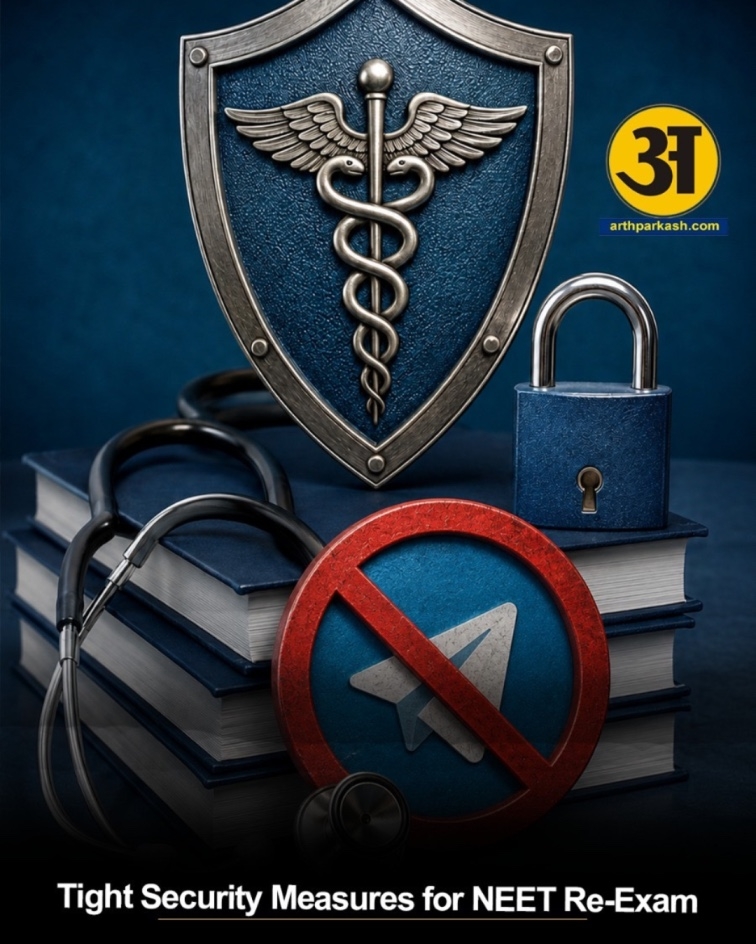
Security Measures for Re-NEET 2026
TOTAL SECURITY: Government Locks Down Teachers and Bans Telegram to Protect Re-NEET 2026
NEW DELHI — In a strong display of corporate panic, the Union Government has launched a multi-front security system. Moving far beyond traditional test-center policing, the Ministry of Electronics and Information Technology (MeitY) has temporarily banned the messaging app Telegram nationwide until June 22, 2026. Concurrently, the National Testing Agency (NTA) has placed question paper setters, translators, and moderators into a strict, military-like physical lockdown.
These extreme steps come just days before 2.2 million students are scheduled to retake the National Eligibility cum Entrance Test-Undergraduate (NEET-UG) on June 21, 2026. The initial May 3 exam was canceled entirely following a mass-multi-state paper leak ring that sparked national outrage.
Yet, as the center calls on the Indian Air Force to transport physical question papers and cuts off communication channels for millions of ordinary citizens, a pressing question hangs heavily over the entire exercise: What is the actual point of all this now?
To an exhausted community of aspirants and parents, this strong display of governmental muscle feels less like a genuine solution and more like a performative exercise in image repair—a brutal attempt by a compromised government to show its skills while subtly punishing the very students that dared to expose its failures.
The Digital Fortress: Solving Loopholes or Deflecting Accountability?
To defend blocking a platform used by over 150 million citizens in India, the government has pointed to the very nature of modern, digital leaks.
Acting on an urgent request from the NTA, authorities invoked Section 69A of the Information Technology Act to ban access to Telegram over the high-stakes exam weekend.
According to official reports, alleged, cheating networks were creating “after-the-fact” evidence using Telegram’s message-editing feature.
- The Setup: Days before the test, an anonymous channel admin would upload a blank PDF file or a generic greeting.
- The Switch: Once the official exam concluded, the admin would use the edit tool to replace the file with the actual exam questions.
- The Illusion: Because Telegram retains the original, pre-exam timestamp on edited posts, it created the illusion that the paper had been leaked hours or days before the test took place.
To permanently shut down this specific loophole, the government ordered that Telegram remove its message-editing feature across India until June 30, 2026.
While tech desks defend this as a necessary tactic to prevent public panic, internet freedom activists and critics see it as “oppressive abuse.” Silencing an entire nation's primary communication network because an agency cannot secure its own data is almost completely unreasonable.
Criminal organizations will simply move to other encrypted platforms. The ban serves a dual, darker purpose: it effectively crushes the digital spaces where students previously organized, shared evidence, and raised their voices against systemic corruption.
The Physical Isolation: Masking Systemic rot with Military Optics
While a digital wall has been made around mobile phones, a physical wall has been thrown up around the academic experts behind the examination. In a standard procedure that looks like wartime intelligence operations rather than educational management, paper setters and moderators have been placed under complete physical isolation.
Nearly three weeks ago, this team was moved to a secure, secret location under 24/7 surveillance. Their personal smartphones, laptops, and smartwatches were locked away. They have zero internet access, no external communication, and their work has been heavily separated so that no single human being has access to the full operational chain. To add to the grand scale of the event, the Indian Air Force (IAF) has been tasked to airlift physical examination papers securely across the country.
But this brutal display of physical security completely ignores a terrible irony: the system was already cruel.
For years, NEET candidates have been subjected to deeply humiliating, invasive frisking procedures at exam centers. Students have been forced to cut sleeves, remove religious threads, and strip away pieces of clothing just to enter an exam hall. They are treated as suspects before they even sit down.
If those highly unnecessary, disrespectful restrictions still failed to prevent such a large paper leak in May, why should anyone believe that locking teachers in a room and using military aircraft will fix the problem? Leaks do not occur because a teacher walked out of a room with a smartphone; they happen because high-level insider networks trade futures for cash.
Proving Competency at the Cost of Student Lives
From the outside, the scope of the enforcement may appear to be a government acting decisively. To the students who live it, it looks like a smokescreen.
When a national system fails this severely, it breaks something fragile. In the weeks following the cancellation of the initial exam, multiple young aspirants across the country took their own lives, broken by the crushing weight of knowing their years of intense 14-hour study days were ruled meaningless by institutional corruption.
A government genuinely moved by this human tragedy would focus on root-level accountability, deep administrative reform, and rebuilding the broken psyches of its youth. Rather, the country has chosen to show off its absolute power. The message is clear: the government is desperate to prove it can "do something," even if that something means treating 2.2 million traumatized teenagers like inmates in a maximum-security prison.
What Lies Ahead: A Culture of Compliance
As the June 21 retest gets closer, the atmosphere across India is not one of academic focus but of center-enforced obedience. The temporary app ban is scheduled to expire on June 22, and the isolated educators will finally be permitted to return to their normal lives.
The Central Bureau of Investigation (CBI) continues its slow-moving probe into the underground network responsible for the initial May leak. But for the millions of young minds entering the examination halls this Sunday, the systemic rot remains unaddressed. No amount of military transport, digital censorship, or high-security theater can mask the grim reality: the center is hiding its own vulnerability behind a wall of pure intimidation.
A Note on Student Support:
If you or someone you know is struggling with the intense pressure, anxiety, or emotional distress surrounding the upcoming examinations, please reach out for help. Free, confidential institutional support can be reached via the National Tele-Mental Health Programme (Tele-MANAS) at 14416 or 1800-891-4416.
Related News